
Analyze fanout results: verify a selection and hand it to SEO Fanout
Start analysis with provenance and the actual selection. This exercise sends two known OpenAI query strings to SEO Fanout and obtains local work assignments. Date, language and original domain scope remain visible; demand, exact query/source relationships and the next page decision require separate review.
Use this for a concrete export or handoff step. Matthias Ramahi owns AI Fanout and SEO Fanout. The exercise reuses approved 27 August 2026 data and makes no additional AI request.
Choose the appropriate result typeOpen the tool and distinguish native API observations from modelled ideas. The exercises here reuse already published data.Open the free fanout tool- Select the two pricing queries
Leave only Ahrefs pricing official and Semrush pricing official checked below.
- Open the handoff and check scope
Expect two queries, 13 original domain names and en/US from 27 August 2026.
- Accept the work assignment
Review the first-party pricing check and retain missing demand and existing-page evidence in the worksheet.
Record provenance, status and selection before analysis
The exercise starts with published record seo-tools-comparison-sources: Ahrefs vs Semrush for small business, OpenAI, gpt-5.6-luna, en/US, 27 August 2026 at 13:13:59.201 UTC, response status completed. It contains four exposed query strings and 13 domain names at action/run scope. We do not rerun it for this exercise.
Select Ahrefs pricing official and Semrush pricing official. The broad comparison and review queries are excluded. All 13 domain names still belong to the original larger run. They are not a new source list exclusively for those two selected queries. The published normalized record also contains no exact source URLs.
A selection CSV, full native export and this handoff are different data products. The handoff uses ai-fanout.seo-research-handoff/1.0 and transfers the selection with context. It does not replace the full API response. The German guide keeps the original English run at en/US; translating the interface does not change its locale.
For the next step, use the selection/full-export distinction.
Transfer the published selection
For acceptance, leave only the two pricing queries selected. The counter must show two. Clearing every checkbox disables transfer. Strings remain unchanged; this control neither generates provider output nor invents intent tags.
The button opens the real receiver at seo-fanout.com/tool/. Versioned JSON travels as Base64url in the URL fragment. This is not encryption: anyone with the complete link can read its content. Use only data you intend to provide to this receiver. This exercise contains already public owner-run data.
The receiver reads the fragment, removes it from the displayed URL and processes the data in the browser. An unknown contract or invalid payload must not silently trigger a new run. Our public selection provides neither full answers nor newly measured search volumes. The diagram shows which information remains at each step.
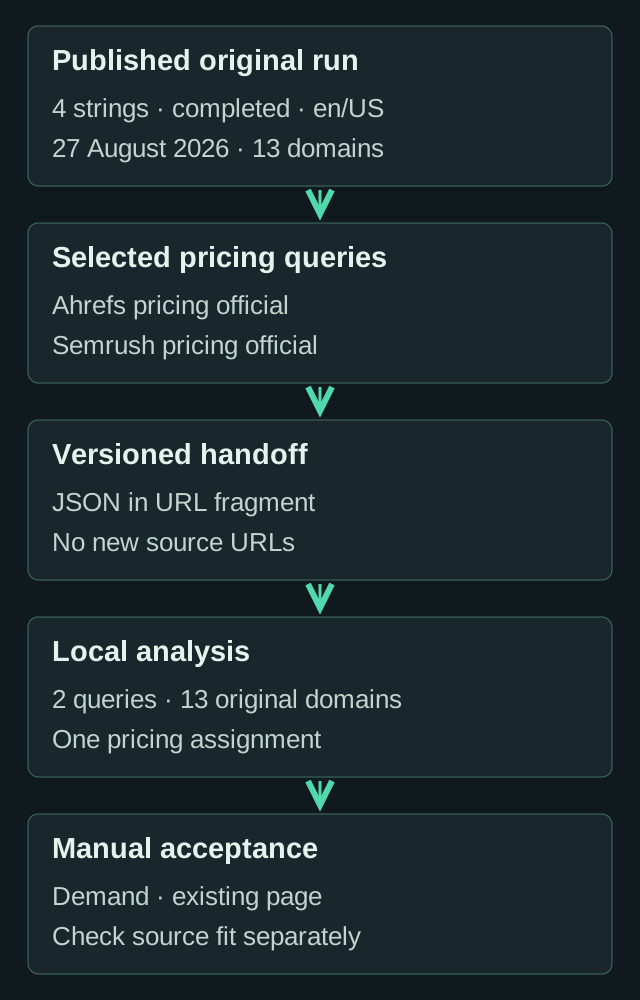
Approved OpenAI run from 27 August 2026: four strings, completed, en/US. Select the queries you want to investigate.
The receiver gets selected strings and the original run's 13 domain names. Exact source URLs and query mappings are absent. Matthias Ramahi owns AI Fanout and SEO Fanout.
Check local output against explicit acceptance criteria
Open View the raw transferred queries and source scope in the receiver. The table must show exactly Ahrefs pricing official and Semrush pricing official. The summary reports two queries, 13 domain names and original run context. Because language remains en, analysis is English. completed remains in the evidence label; transfer time differs from provider-run time.
Rule-based analysis groups both pricing queries into First-party pricing check. Its assignment requests dated plan names, billing periods and material conditions. That is a research assignment, not a freshly verified price table. The original comparison question remains context; the other two queries are outside the transferred set.
The domain list must not appear as a proven query/source join. Demand, existing pages and source fit remain open checks. The completed acceptance worksheet therefore separates transport from editorial decisions: a correct transfer can still leave a new page unjustified.
For the next step, use the separate demand review.
You can complete the same acceptance check without following an external link. Record the two strings, original metadata and broader domain scope in the worksheet. Then write one pricing-check assignment and verify current first-party sources yourself. The downloadable example handoff contains the same selection; the worksheet makes losses or invented relationships visible.
For the next step, use the editable content brief.
Common questions
These short answers cover recurring questions from tool use and source review. They are not claimed search-volume data.
- Does this exercise make a new AI request?
- It selects already published strings. The receiver applies local rules to create work assignments; the exercise does not start a second provider run.
- Do all 13 domains belong to each selected query?
- The domains belong to the original larger run. Exact query mapping and source URLs are absent and must not be invented.
Sources used
These sources support the functions and limits described here. They do not prove claims beyond that scope.
- Owner-run selection and local receiver checksOpen source
Two selected approved OpenAI strings, original en/US time/status and original 13-domain pool; versioned fragment handoff and rule-based receiver. No fresh provider call, invented source URL, query/source join, ranking or independent endorsement. Vendor rows remain documentation-only.
- Current website export contracts and reference validationOpen source
Draft 2020-12 reference for the current native/modelled full runs, query selections and local comparisons. Schema checked against actual service/export functions with synthetic provider stubs and semantic negative tests. No root schemaVersion is invented for full runs. Legacy planner and handoff formats remain separate.
- Dated OpenAI fanout example observationsOpen source
Four owner-run OpenAI API observations record exact inputs, timestamps, exposed query strings, search-action source domains, usage, method versions and response status. Versioned JSON, normalized CSV and a JSON Schema are published. They are not an independent benchmark.