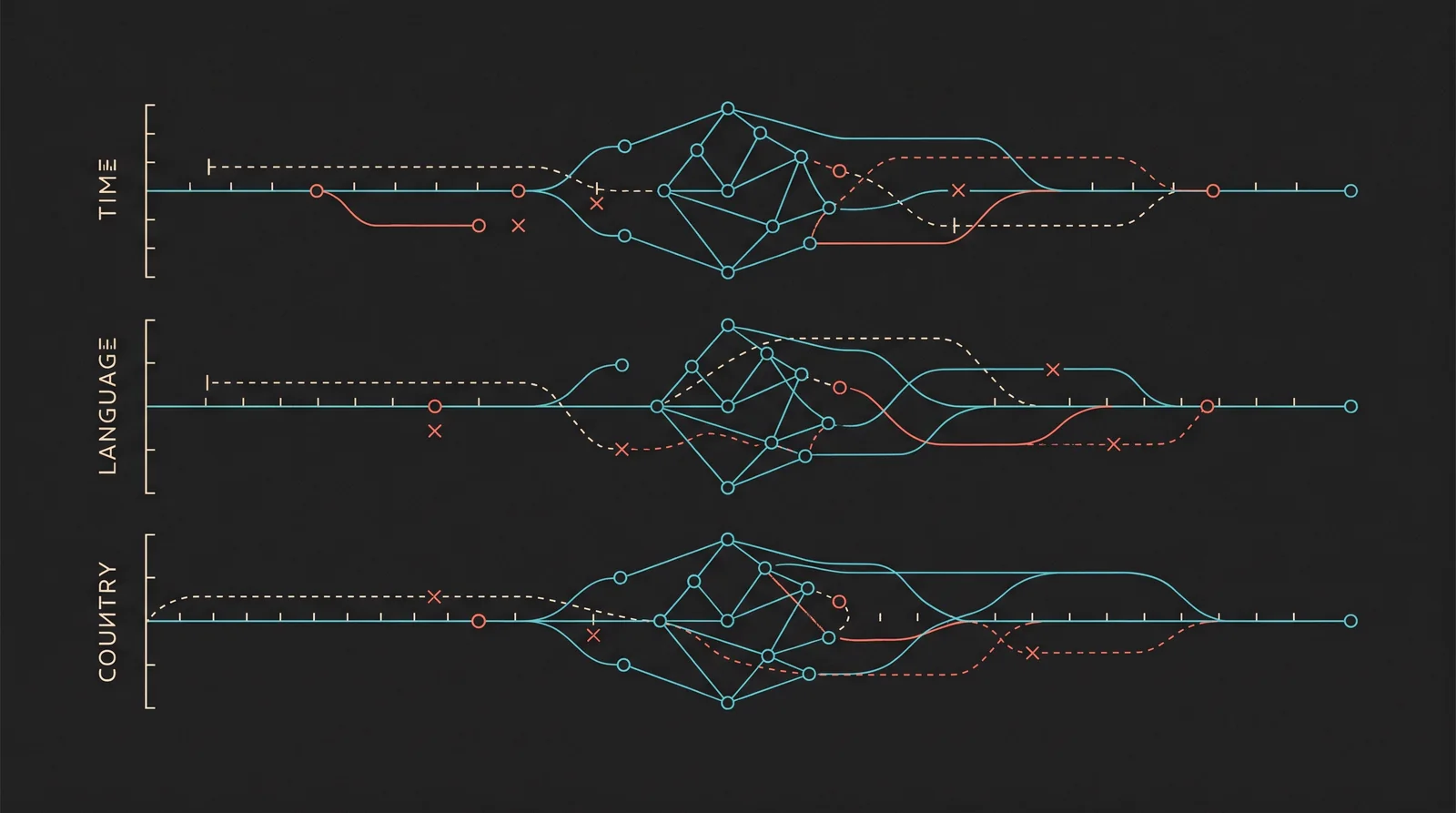
A query fanout experiment template for repeatable review
A useful fanout experiment defines the question, conditions, comparison and stop rule before running. Count completed zero-query observations separately from failed attempts. The template organises the experiment; it is not a published benchmark.
Use this when existing permitted data cannot answer a narrow question. The completed ledger contains only invented states and incurs no API cost.
Use a question you actually need to investigateStart with existing material or the appropriate tool mode. The worksheets require no additional provider run.Open the free toolDefine the question and comparison beforehand
Investigate a bounded question: for example, whether your review distinguishes a completed run without a query field from a timeout. A synthetic fixture may already answer that. A new paid provider run is useful only when existing permitted material cannot answer the actual research question.
Record endpoint, exact model identifier, date, topic, market, language and tool configuration. Native API observations and modelled ideas are different evidence classes. You can describe both, but cannot silently count them as one observed search set.
Define transformations beforehand too. Exact strings, normalised strings and shared domains answer different questions. If you standardise case or whitespace, retain the original text alongside it. Normalisation creates no new query-to-source relationship.
Next, you can compare API observations.
The Markdown template connects conditions, comparison rules, an attempt ledger and a disposal deadline. In the example, provider and model identifiers remain placeholders because no actual response is claimed. Replace them only with information you have really checked.
Use completed runs as the denominator without inventing zeros
In the teaching file, attempt A completes and exposes zero query strings. Attempt B times out and has an unknown query count. That leaves one completed run and one separately reported failed attempt. Saying two runs returned no queries would be incorrect.
Record missing model or usage information as unknown. A timeout does not establish whether the provider searched internally or incurred cost. The synthetic exercise incurred no costs; a real experiment needs actual usage information or a clearly labelled estimate.
One successful comparison may describe differences but cannot establish a stable probability. Choose repetitions and analysis for the specific question, permissions and budget. Record deviations instead of silently removing inconvenient attempts from the outcome story.
Preserve query, action and run sources at their existing scope. A run source cannot be assigned to every query simply because your comparison expects a rectangular table.
Set separate cost, retention and publication boundaries
Define a hard budget and stop point before making new requests. The protocol is not permission for paid research. A private review opportunity likewise does not authorise a public raw-output archive or benchmark.
Next, you can report a bounded observation.
This tool's optional browser history retains at most 20 runs for 30 days and removes Gemini grounding and search-suggestion data. It is not an unrestricted research archive. Plan the storage location, permitted fields and disposal date for your actual agreement.
The final report states conditions, completed attempts, failures and limits. It should report a reviewable observation without inventing consumer search traces, ranking chances or market demand. The effect of a content change needs a separate website measurement plan.
Next, you can measure website content changes.
Sources used
These sources support the functions and limits described here. They do not prove claims beyond that scope.
- Original prioritization, source-audit, measurement, repetition and reporting artifactsOpen source
Twenty blank/worked-example files and the end-to-end fictional buying-guide workflow. Source-audit rows review public primary guidance and owner disclosure. Measurement arithmetic and attempt states are explicitly synthetic, not website results, client outcomes, provider responses or benchmarks. No paid requests or new retained grounding output.
- Optimizing for generative AI features on Google SearchOpen source
Normal SEO foundations remain relevant; pages made primarily for fan-out variations are not the accepted content model.