
What is query fanout in AI search?
Query fanout turns one question into several narrower searches. For SEO and content research, those branches can reveal questions, comparison criteria and evidence your page may need to address.
Start with the meaning, then test one topic in the free query fanout generator. Native mode reports searches exposed by a provider API; Search Ideas generates ten possible research directions without web search.
See a fanout for your own topicEnter one short question and inspect the search queries and sources OpenAI or Gemini exposes in that run.Try the free fanout tool- Choose one reader decision
Use a short topic such as best SEO tools. Keep the audience and market specific enough to make the result useful.
- Inspect the exposed searches
Choose OpenAI or Gemini in Native fanout. The result may contain several query strings, fewer than expected, or none.
- Check your existing page
Ask which reader questions the branches represent. Add missing explanations or evidence where they serve the same page; check demand separately.
What Google AI Mode query fan-out means
Google says AI Mode can break a question into subtopics and issue several related searches. That documented query fan-out technique helps Search gather information across different parts of a complex question.
This does not provide a public list of every query from a private AI Mode session. ai-fanout.com observes fields exposed by selected provider APIs; it does not inspect Google Search or AI Mode traffic.
Take “best SEO tools”. One person may want a shortlist, another needs current prices, and an agency may care about audits, reporting or client access. A short starting phrase hides those different jobs. A web-enabled AI system can split the topic into narrower searches before answering.
The exact branches depend on provider, model, settings and time. A run might cover a general comparison, named products, pricing and a particular feature. Another run can make a different choice without either list becoming a complete map of the topic.
See how one comparison question split into narrower searches in the dated Ahrefs–Semrush example.
Query fanout, expansion and rewriting
The terms describe related operations, not identical evidence. Google documents fan-out; query expansion adds related terms; OpenAI describes rewriting into one or more targeted queries.
| Term | Useful distinction | What it does not establish |
|---|---|---|
| Query fanout | Several related retrieval queries address parts of one information need. | A private, complete list of queries from a consumer session. |
| Query expansion | Related terms or synonyms broaden a query's vocabulary. | That a system executed several separate web searches. |
| Query rewriting | The request is reformulated for retrieval; OpenAI describes one or more targeted searches. | A universal one-query-only rule or the response fields of another product. |
| Prompt-generated search ideas | A model suggests questions for a research plan. | Executed searches, human search demand or a guaranteed citation. |
Fanout is part of retrieval, not the final answer
Search queries are intermediate actions used to find documents. A query does not prove that the provider accepted every result, and a cited page does not reveal how much it influenced the final answer.
One search action can contain several query strings. ai-fanout.com therefore reports search actions, exposed queries and sources separately instead of inventing a one-to-one relationship.
Some provider APIs return search-action objects, query strings and source annotations. When a query string is present, this site can report it as an observation from that named run.
The site does not inspect ChatGPT or Gemini consumer interfaces, browser network traffic, system prompts, private retrieval traces or chain of thought. An API observation is useful evidence, but not a capture of every internal step.
What the result is useful for
The list can reveal wording, user jobs and source needs that were easy to miss. Use it to review an existing page, plan research and decide what deserves closer investigation.
If you want to plan possible questions before observing a run, use the query fanout prompt template.
It is not search-volume data, a stable keyword set or a publishing plan. Several queries may belong on one strong page, while another branch may have no measurable demand or relevance.
For the next page decision, follow the query fanout content workflow.
Record the topic, provider and exact model, language, country, time, tool version and method version. Without them, two screenshots cannot be compared responsibly.
- Topic and locale
- Provider and model
- Date and time
- Tool and method version
One continuous example: from a topic to a research assignment
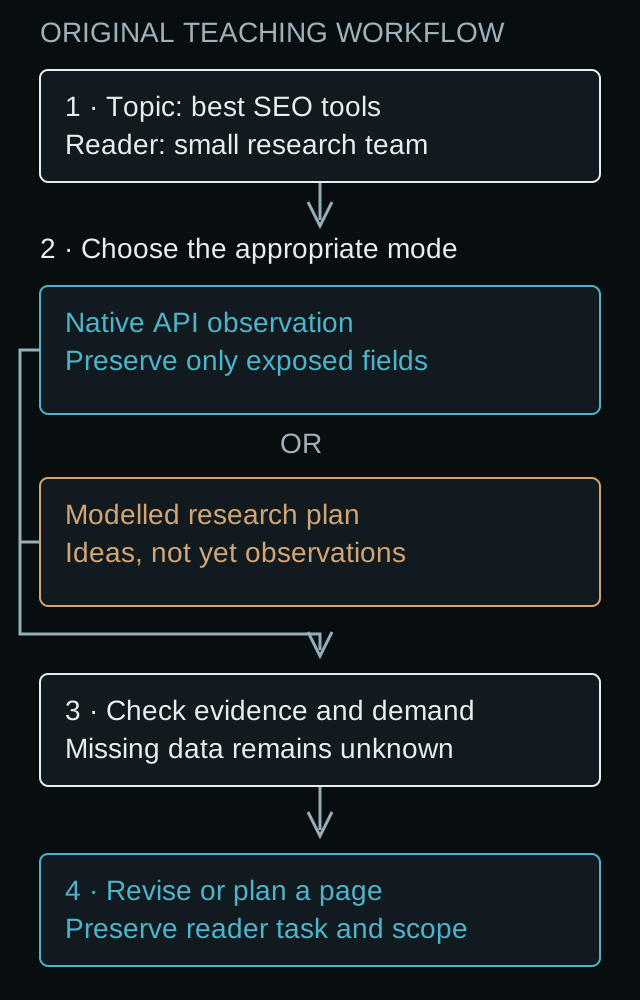
Take best SEO tools for a small research team. The input names a topic, not a completed purchase decision. The team needs suitable tasks, current seat costs and a reliable export route. These three needs are our editorial interpretation; they do not automatically come from a provider response.
The diagram shows our working process. Native mode preserves only fields exposed by a particular API run. The separate planning mode produces modelled questions. Either route can prepare a research assignment, but a generated idea remains an idea. This is not a diagram of Google, OpenAI or Gemini's internal architecture.
The already published best-seo-tools-us OpenAI example from 27 August 2026 records four query strings and one search action. Its run status is incomplete. The domain list includes ahrefs.com and semrush.com. That establishes neither a product recommendation nor a supported source for every query. Our reader questions still require current product evidence.
For the next step, use the annotated product-comparison brief.
For an existing comparison page, a verified seat-cost section may suffice. A CSV-import tutorial serves a different task: transferring a file correctly. The reader's decision and the existing inventory determine whether a section or another page is useful. A large number of search branches does not replace that review.
Common questions
These short answers cover recurring questions from tool use and source review. They are not claimed search-volume data.
- Does Google AI Mode use query fan-out?
- Yes. Google documents that AI Mode can break a question into subtopics and issue multiple related searches. That public description explains the technique, but it does not expose a private list of every query from an individual AI Mode session.
- Is query fanout the same as keyword expansion?
- Not exactly. Keyword expansion produces related terms for research or advertising. Query fanout describes searches an AI-enabled retrieval system may issue while answering a particular question. The phrases can overlap, but the evidence and purpose are different.
- Is this the same as hidden ChatGPT searches?
- No. The tool reports search actions exposed by a documented provider API run. It cannot reveal private consumer-chat traces, internal reasoning or every lookup a consumer product may perform.
- Why can one input produce several queries?
- A broad question can require definitions, comparisons, prices or local details. When the provider exposes several query strings in its search action, the tool lists those observed branches separately.
Sources used
These sources support the functions and limits described here. They do not prove claims beyond that scope.
- Original annotated workflow, controls, prompts and export exercisesOpen source
Original diagrams and editorial annotations; only the previously approved normalized OpenAI records. Synthetic selection files use actual producers and independent CSV readback, not new provider output or Excel/Sheets import. Own dated public-page checklist makes indexing and outcomes explicitly unproven.
- Google Search: AI features and your websiteOpen source
Google guidance on search eligibility, established SEO practices and Web reporting; no ranking or citation guarantee.
- Introduction to Information Retrieval: query expansionOpen source
Supports the vocabulary-expansion distinction. It does not document the internals or exact queries of a current consumer AI search session.
- AI features and your websiteOpen source
Google describes query fan-out publicly without exposing a general private-query inspection interface.
- AI Mode in Google Search: updates from Google I/O 2025Open source
Google states that AI Mode uses query fan-out to break a question into subtopics and issue multiple searches; it does not provide ai-fanout.com with a private AI Mode query trace.
- OpenAI web search tool guideOpen source
Documents web_search_call output and search actions that usually, but not always, include the query or queries searched. Search actions, exposed strings and cited sources therefore need separate interpretation. It does not expose chain of thought or guarantee that every route returns query strings. Rechecked for the original 2026-10-10 zero-query decision table; no new provider observation is published.
- Searching the web with ChatGPTOpen source
OpenAI explains that ChatGPT Search can rewrite a question into one or more targeted queries and can issue more specific follow-up searches; this description does not expose a private ChatGPT search history to ai-fanout.com.
- Gemini grounding with Google SearchOpen source
Documents Gemini 3.7 Flash Google Search, google_search_call arguments.queries, cited URL annotations and per-query billing.